

Every New Zealand business needs an IRD number. What else you register for depends on your structure, your turnover and whether you plan to hire staff.
*Every fee, threshold and rule in this guide comes from official New Zealand government pages, as at October 2026.
What are the steps to start a business in NZ?
The government's own guide, business.govt.nz, breaks it into five steps.
- Make sure your idea is viable.
- Choose and secure your business name.
- Choose a business structure.
- Register with government agencies.
- Look into the regulations that apply to your industry.
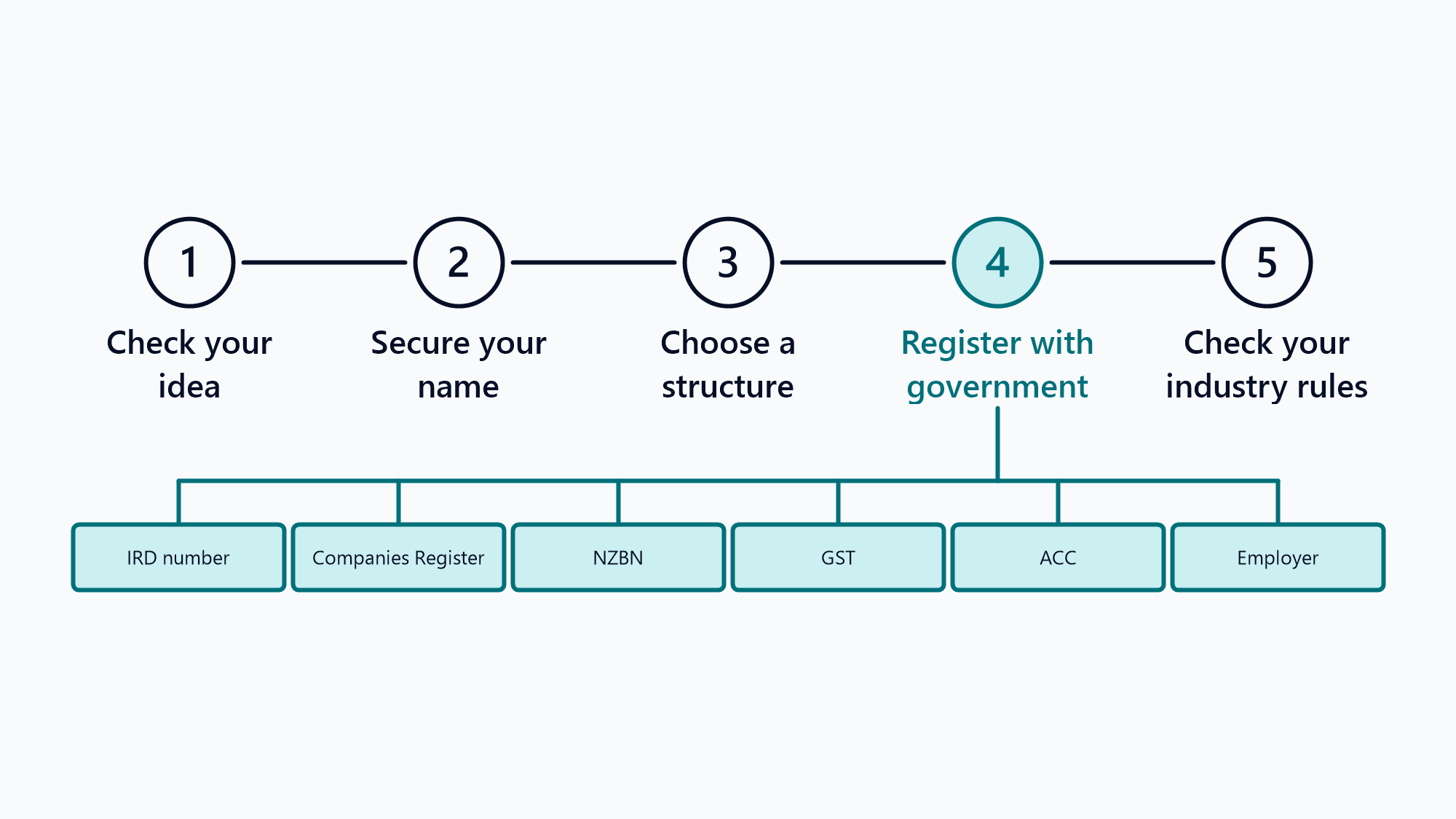
The five steps, with the registrations that may apply to you at step 4.
The paperwork stops at step 5, but it doesn't get you customers. We add one more step at the end of this guide: getting found on Google.
How do you know your idea will work, and is the name free?
Before you spend money on anything, find out whether people will pay for what you offer. Business.govt.nz lists five questions worth answering honestly first:
- Do I have what it takes? You need passion, persistence and a willingness to take risks.
- Am I willing to learn and be flexible? At the start you do a bit of everything, from bookkeeping to marketing.
- Will I solve a problem or fill a need?
- Who will I be competing with?
- Can I charge a price that covers my costs?
The last one is where many ideas fall over, so put numbers on it: what you will charge, what each job or sale costs you to deliver, and how many sales you need each month to break even. The same page adds a piece of advice that is easy to ignore and worth following: talk to people who can guide you, such as accountants, business mentors and people connected to your industry.
Once the idea holds up, check the name before you print anything with it on. ONECheck searches business names, trade marks, website domains and social media usernames in one place. A clash can cost you the name: sole traders can't advertise under their personal name if someone has already registered it as a trade mark in the same industry.
Should you be a sole trader or a company?
Most small businesses start as one of three structures. Business.govt.nz compares them like this:
Sole trader | Partnership | Company | |
|---|---|---|---|
Who owns it | One person | Two or more people or organisations | Shareholders, as a separate legal entity |
Debts | You are personally responsible for all of them | All partners are liable for the partnership's debts | Shareholders are responsible only up to the value of their shares |
Setup | Cheapest and easiest | Relatively easy, but you need a partnership agreement | More complex, with extra rules to follow |
Credibility and investment | Lower credibility, so investment is harder | Good for attracting investment | Greater credibility, and easier to attract investment |
There is no single right answer. A sole trader is the quickest way to start, and a company protects your personal assets if something goes wrong. Business.govt.nz suggests talking to someone who uses the structure you are considering, or getting advice from an accountant or lawyer. We are a marketing agency, not accountants or lawyers, so treat this guide as a map and check your own situation with one of them.
Which government registrations do you need, and what do they cost?
Most of these apply only in certain situations. Here is each one and who needs it.
Registration | Who needs it | What to know |
|---|---|---|
IRD number | Every business | Sole traders use their personal IRD number. A company gets one when it incorporates. |
Companies Register | Companies only | Reserve the name, apply to be listed, and complete an annual return each year. |
NZBN | Optional | Recommended because it reassures suppliers and customers that you are a business. Free for sole traders, partnerships and trusts. |
GST | Turnover of $60,000 or more | Also required if you add GST to your prices. Below the threshold, registering is your choice. |
ACC levies | Sole traders | Sole traders get ACC personal injury cover automatically. Your first levy invoice arrives after the end of your first year in business, then once a year, usually in July or August. |
Employer registration | When you employ staff | Register as soon as you start employing, through myIR or with form IR334. |
The numbers that matter, from the official sources:
Key facts, as at October 2026
Company name reservation: $10, plus GST.
Applying to incorporate a company: $118.74, plus GST.
Company annual return: $49.74, plus GST, every year.
NZBN for sole traders, partnerships and trusts: free.
GST registration: required at $60,000 of turnover in the last 12 months, or expected in the next 12 months.
So a company costs $128.74 plus GST to reserve a name and incorporate, and a sole trader can start for nothing. Costs beyond registration, such as insurance, tools, stock or a website, depend on your business.
One more check before you sign a lease or buy stock: your industry may need a licence or permit. Business.govt.nz points to its Compliance Matters tool to find out which central and local government rules apply to you.
How will customers find your new business?
Once you're registered, nobody knows you exist yet. The first free step is a Google Business Profile. Google says you can add or claim your business at no charge, and once it is verified, customers can find you on Search and Maps. Verifying also lets you edit your business details and interact with customers.
Getting found on Google is our work. You can see how Google SEO and Google Ads fit together in one monthly plan, or get your free proposal and we will tell you what we would do for your business.
Sources
- Business.govt.nz, Starting a business and 5-step guide to starting a business
- Business.govt.nz, Questions to ask yourself before you start
- Business.govt.nz, Choosing the right business structure
- Business.govt.nz, Becoming a sole trader and Registering with government agencies
- Business.govt.nz, ONECheck
- Inland Revenue, Self-employed, Registering for GST and Register as an employer
- Companies Register, Starting a company and Schedule of fees
- Google Business Profile Help, Add or claim your Business Profile and Verify your business on Google